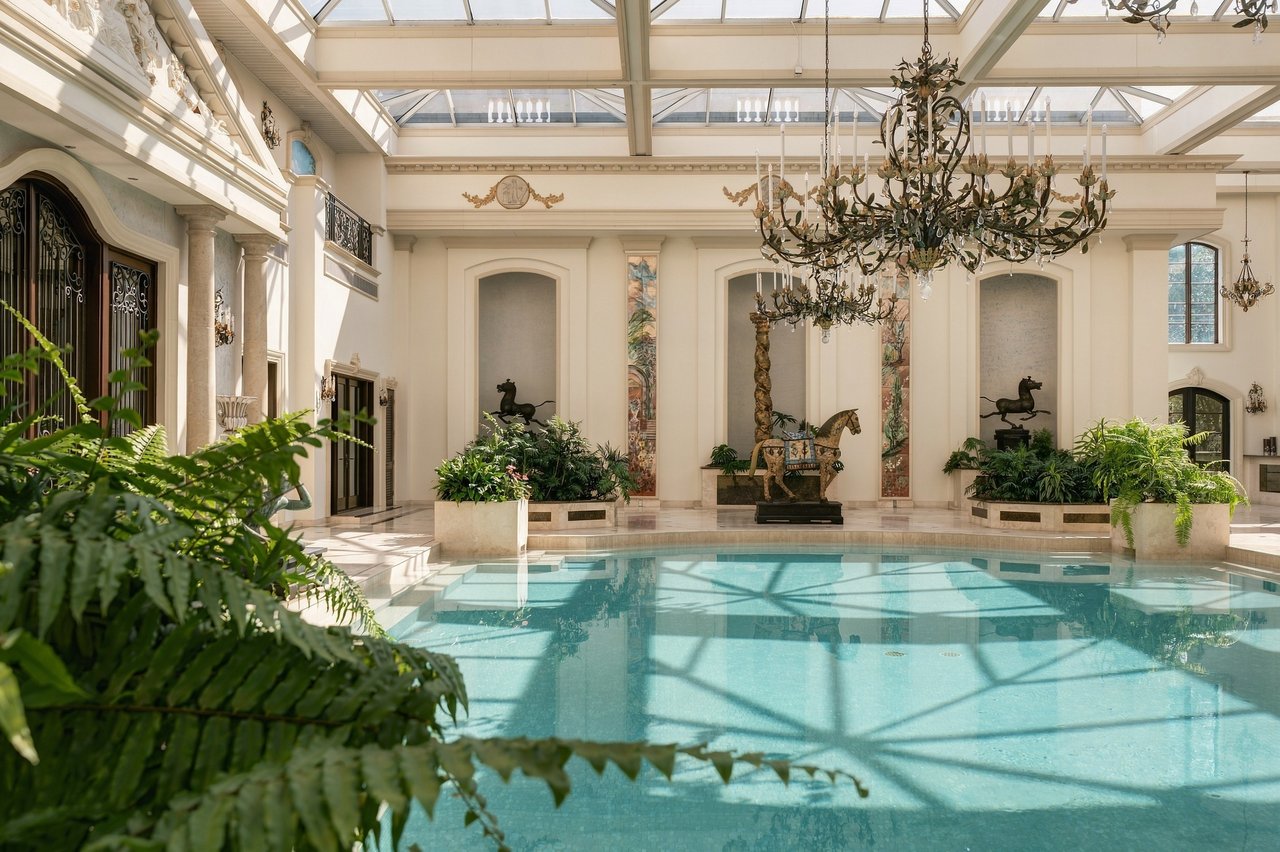
Behind the classical façade of 2115 River Oaks Boulevard stands something rarely encountered in American residential architecture: a 12,000-square-foot, glass-enclosed entertainment pavilion built around an indoor swimming pool. Chandeliers hang beneath its geometric glass ceiling. Travertine marble surrounds the water, and a second-floor balcony overlooks a room conceived for entertaining on an unusually ambitious scale.
The pavilion owes its existence to Baron Enrico “Ricky” di Portanova and his wife, Baroness Alessandra di Portanova, a couple whose parties became part of Houston's social history during the 1970s and 1980s.
Their home brought together European architectural influences and the considerable resources of a Texas oil fortune. Movie stars visited, friends gathered after charity galas, and stories circulated about evenings that seemed more suited to a Hollywood film than a private residence in Houston.
Decades after the couple's deaths, the Baron di Portanova mansion remains among the city's most recognizable private homes. Its history offers an unusually personal account of the wealth, ambitions and social customs that shaped twentieth-century Houston.
River Oaks and the emergence of Houston's wealthy elite
To understand the di Portanova estate, it helps to understand the neighborhood in which it stands.
Established in the 1920s, River Oaks was conceived as a carefully planned residential garden suburb. Its developers engaged Kansas City landscape architecture firm Hare and Hare to prepare a master plan that respected the area's natural surroundings and established unusually rigorous standards for residential development.
Architectural review, deed restrictions and substantial minimum construction requirements helped establish River Oaks as an exclusive residential community. Its early history also included discriminatory practices that restricted access to minority groups, reflecting the inequalities underlying many affluent American suburban developments of the period.
According to the Texas State Historical Association, the neighborhood became influential in Houston's broader development and attracted some of the city's most distinguished residential architecture.
Among its notable early residences was Bayou Bend, the Hogg family home designed by John F. Staub and Birdsall P. Briscoe.
As Houston's petroleum industry expanded, River Oaks became closely associated with the families whose fortunes were built through oil and other industries. Their residences reflected changing architectural tastes, from restrained Georgian and Colonial Revival houses to considerably more elaborate interpretations of European architecture.
The di Portanova estate belongs to a later period in that history, when Houston's wealth was becoming increasingly international.
Who was Baron Ricky di Portanova?
Enrico di Portanova, known to friends and Houston society as Ricky, was the grandson of Hugh Roy Cullen, one of the most influential figures in Texas petroleum history.
His mother, Lillie Cranz Cullen, married Italian Paolo di Portanova. Following his parents' divorce, Ricky and his younger brother Ugo were raised in Italy with their father.
Although the family used the aristocratic title of baron, its formal legitimacy has been questioned in published accounts. Ricky nevertheless became widely known by the title throughout his adult life.
His connections to Houston came through his mother's family. When Cullen died in 1957, Ricky was living in Rome and had spent much of his life apart from the American relatives whose wealth would eventually transform his circumstances.
He came to Houston in the early 1960s, reportedly borrowing money to finance the trip and obtain legal assistance. What followed was a prolonged dispute concerning his entitlement to the Cullen family fortune.
By the following decades, di Portanova had become an established figure in international society, maintaining residences in the United States, Italy and Mexico.
The Cullen family oil fortune
Hugh Roy Cullen's career followed a distinctly different course from that of his grandson.
Born in Denton County, Texas, in 1881, Cullen entered the petroleum industry after earlier ventures in cotton and real estate. His success drilling for oil earned him a reputation as one of the industry's leading independent producers.
The Handbook of Texas credits him with major discoveries at several Texas oil fields. He eventually established Quintana Petroleum Company.
The Cullen family's contributions to Houston extended into education and medicine, helping shape institutions whose influence continues today.
Ricky di Portanova's inheritance represented a subsequent generation of that accumulated wealth. His upbringing in Italy and preference for international travel gave his life a character considerably different from that of his Texas grandfather.
At River Oaks Boulevard, those European influences became visible in the architecture of his home.
Alessandra di Portanova and Houston high society
In 1973, Ricky married Sandra Hovas, a native Houstonian who subsequently became known as Baroness Alessandra di Portanova.
Alessandra developed a distinctive public identity during the couple's years together. Her elaborate jewelry collection became particularly associated with her appearance in international society, reflecting the bold Italian jewelry designs popular during the 1970s and 1980s.
Years after her death, Sotheby's would document the provenance of pieces from her collection, including creations by prominent Italian jewelry houses. Some of her jewelry entered Elizabeth Taylor's collection following the dispersal of Alessandra's estate.
The couple traveled extensively, dividing their time among residences in Houston, Rome, Palm Springs and Acapulco. Their social circle extended beyond Texas and included prominent figures in entertainment and international affairs.
In Houston, their evenings frequently continued long after the conclusion of formal society events.
Writing for PaperCity, longtime society journalist Shelby Hodge recalled the couple's habit of inviting friends home following charity galas, where Ricky sometimes prepared late-night pasta for guests.
Their philanthropic legacy also survived their lifetimes through the Enrico and Sandra di Portanova Charitable Foundation, whose publicly available tax filings document contributions to charitable organizations.
A River Oaks mansion designed for extraordinary entertaining
Contemporary property records date the residence at 2115 River Oaks Boulevard to 1968, several years before Ricky and Alessandra married.
By the mid-1970s, according to historical accounts, the couple had begun transforming the property. The most consequential alteration involved enclosing the backyard and integrating it with the existing residence.
The project produced an architectural feature that would define the mansion for generations: an immense, air-conditioned indoor pool pavilion.
Its construction was an unconventional decision in a neighborhood known for carefully maintained gardens and traditional residential architecture. Contemporary and retrospective accounts describe the scale of the addition as a source of considerable discussion among neighbors.
The completed building accommodated the di Portanovas' particular approach to entertaining. It provided room for large gatherings throughout the year, regardless of Houston's summer temperatures.
The legendary glass-enclosed pool pavilion
At approximately 12,000 square feet, the natatorium occupies an unusually large portion of the estate's reported 21,500-square-foot total.
Its steel framework supports a broad glass roof that admits daylight across the interior. Chandeliers introduce the formality of a ballroom into an environment that might otherwise resemble an indoor garden.
A 1982 Texas Monthly profile, subsequently cited by Mansion Global, described the enormous quantities of glass and steel required to enclose the space, along with a swimming pool measuring approximately 40 feet across and extensive travertine flooring.
The scale of the pavilion makes it possible to accommodate distinct dining and reception areas around the pool. Residential rooms open toward the space, and the upper-level primary suite overlooks it.
A transparent stage and facilities for serving food further reflect its intended use as a venue for private events.
From an architectural perspective, the pavilion is significant for how thoroughly it reorganized the residence. An outdoor area ordinarily reserved for gardens and recreation became a substantial part of the home's interior circulation and social life.
The result is a building whose most distinctive architectural feature arose directly from the habits of its owners.
James Bond, Hollywood and the di Portanovas' legendary parties
Few stories associated with the mansion have circulated as widely as the account of a James Bond-themed party attended by British actor Roger Moore.
In one version published by PaperCity, Moore made a theatrical entrance by descending the exterior of the residence in the manner of his famous screen character.
A 2014 CultureMap Houston feature recorded a somewhat different recollection. In that account, Moore arrived by helicopter while costumed models descended the building.
The precise details vary, and the original date of the party remains difficult to establish. Both versions illustrate why the couple's gatherings have remained such a memorable part of Houston society's collective recollection.
Actress Joan Collins also appears in published recollections of the mansion's guests.
The di Portanovas' association with James Bond extended to another of their properties. Their sprawling Acapulco villa, Arabesque, appeared in the 1989 film Licence to Kill, starring Timothy Dalton.
Arabesque received international attention in its own right and welcomed prominent guests, including political figures and Hollywood entertainers.
The Houston mansion and the Mexican villa expressed a similar preference for large-scale hospitality, adapted to very different locations.
The architecture and evolution of 2115 River Oaks Boulevard
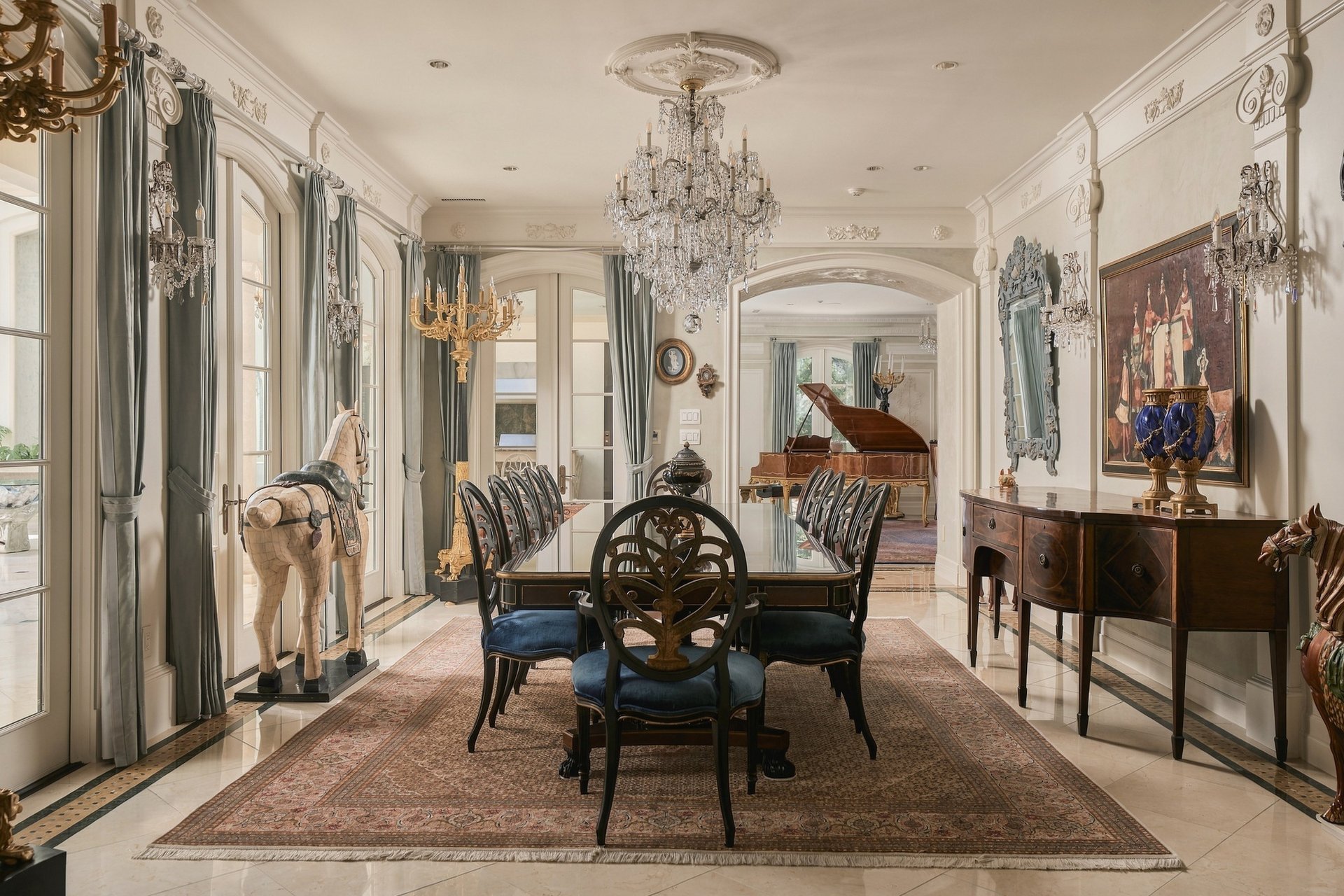
The mansion's present exterior draws heavily from Neoclassical architectural traditions. Its symmetrical composition, central pediment and formal entrance establish a distinctly European character.
A gated forecourt surrounds a circular fountain, while ornamental ironwork and a balustraded roofline contribute to the formality of the building.
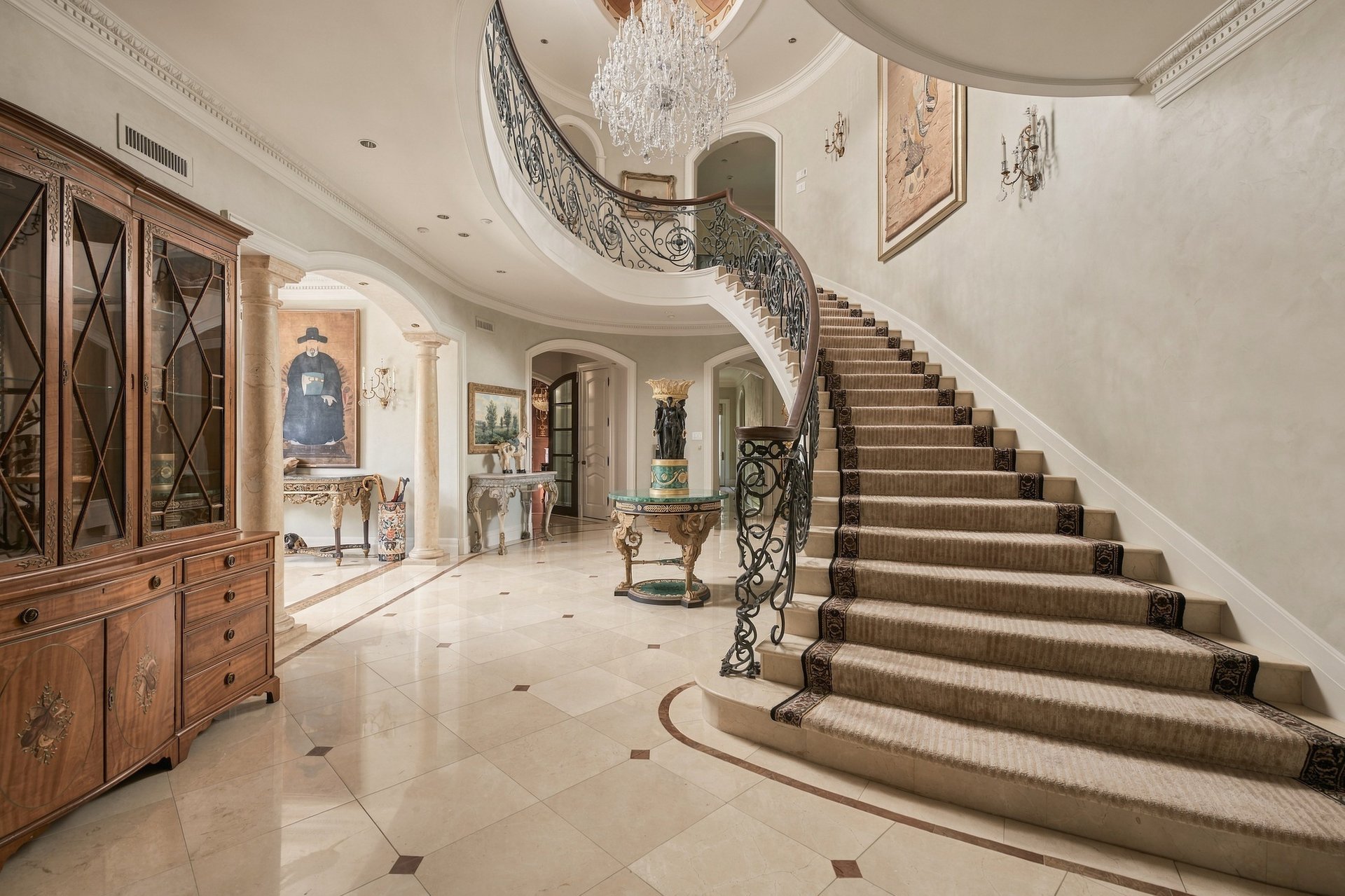
Inside, marble staircases and decorative plasterwork establish the character of the reception rooms. A mahogany-paneled study offers a more enclosed, intimate setting within the otherwise expansive interior.
The residence also incorporates a private cinema, wine storage and separate kitchen facilities intended to support larger gatherings.
Much of the interior visible today reflects work undertaken after the di Portanovas' ownership. Although the couple established the property's architectural identity, subsequent owners have made extensive changes to its finishes, infrastructure and facilities.
Preserving the mansion's architectural identity
Ricky di Portanova died in February 2000. Alessandra died less than two months later.
The property subsequently entered a new period of ownership. In 2002, it was sold to owners who undertook a substantial renovation associated with architect and designer JD Bartell.
Published accounts describe an investment of approximately $7 million in the residence, including extensive interior reconstruction and technological improvements.
The renovation retained the theatrical character of the reception rooms and the defining pool pavilion. These features remained central to the property when it returned to the market in 2021.
A subsequent sale closed in March 2022. The new owners continued updating the estate, introducing improvements to its mechanical systems, windows, doors and entertainment facilities. An elevator was among the later additions.
The resulting residence reflects several decades of architectural decisions. Its present appearance owes much to the di Portanovas' original transformation, alongside the substantial investment of the families who followed them.
A new chapter in the history of 2115 River Oaks Boulevard
In October 2026, the mansion returned to the market through Nancy Almodovar, CEO and co-founder of Nan & Company Properties, Houston's exclusive affiliate of Forbes Global Properties.
Having previously represented the property in its 2022 sale, Almodovar returned as its listing broker. The estate's reappearance attracted international attention, including coverage from Mansion Global, which reported that the property secured a buyer in fewer than three weeks.
For those interested in Houston's architectural heritage, the estate provides an opportunity to reconsider a particularly distinctive period in the city's residential and cultural history.
Many celebrated American houses are remembered for the architects who designed them. At 2115 River Oaks Boulevard, much of the building's character derives from the people who commissioned its transformation and the gatherings they intended to hold within it.
More than half a century after the di Portanovas began enclosing their backyard, that extraordinary glass pavilion remains.