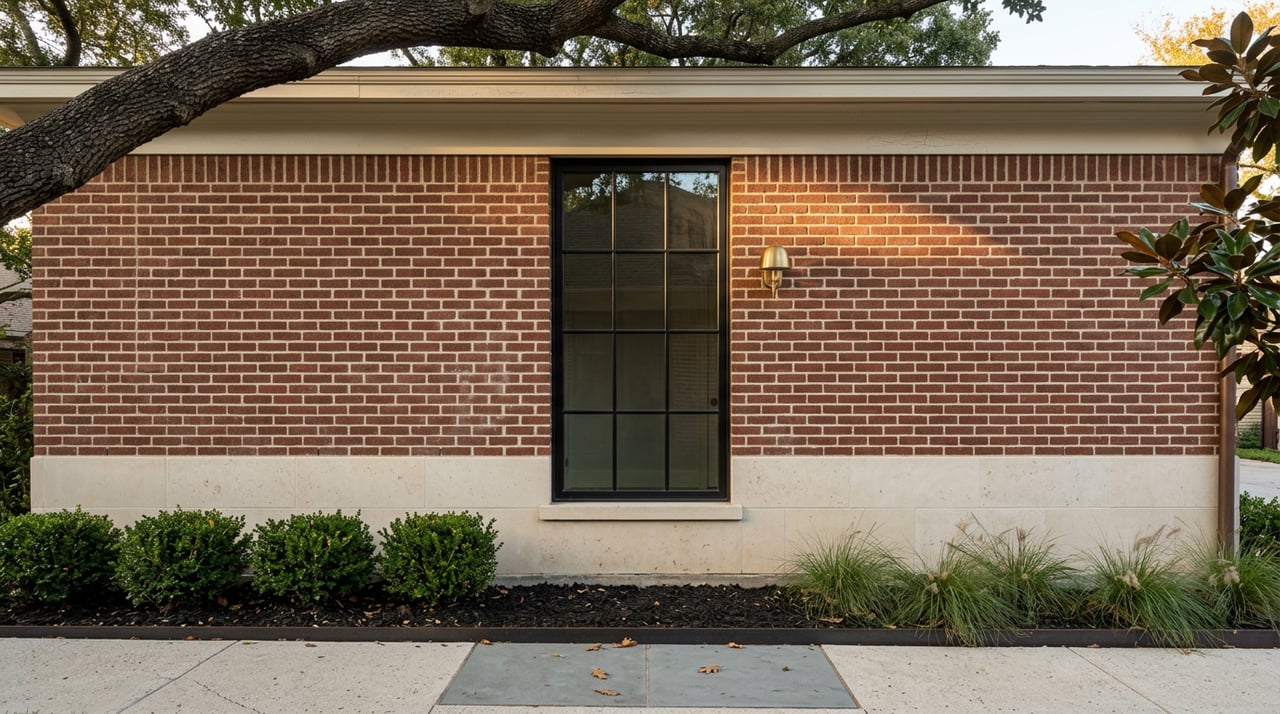
A house on Arnold Street is on the market this spring for $1,395,000. It has five bedrooms, three baths, and 2,665 square feet on a 6,840-square-foot lot. The listing copy is unusually candid: the property is being offered for lot value only. Two streets over on Westchester Avenue, a new Parker-Evans build designed by architect Josh Jones is asking $3,795,000 for 5,600 square feet on a lot of identical width. Same neighborhood, same school zone, same walk to Rice Village. A $2.4 million spread.
If you have spent any time on the portals, you have seen West University Place described as a $2 million market. That number is real. It is also misleading. The neighborhood is not one market with a median. It is two markets stacked on top of each other, and every transaction in West U is negotiating the gap between them.
Three medians, one zip code
The disagreement starts with the indices themselves. Three respected sources publish a "typical" West U price, and they do not agree.
| Source | Reported value | Window | Year over year |
|---|---|---|---|
| Houston Association of Realtors | $2,115,280 average, $564/SF | June 2026 | n/a |
| Redfin | $2,073,929 median sale price | April 2026 | +1.5% |
| Zillow Home Value Index | $1,501,156 | spring 2026 | +4.0% |
The Zillow ZHVI is built from a broad property-level estimate that includes every structure standing today, including the 1940s bungalows still occupying their original footprints. The Redfin and HAR figures are sale-weighted, so they tilt toward what is actually closing, which is increasingly new construction. The $600,000 gap between the indices is not noise. It is the distance between what the existing housing stock is worth and what the replacement housing stock costs.
The lot is the asset
Strip the building off a West U property and a remarkably consistent number appears underneath. A 6,840-square-foot interior lot is being offered for lot value at $1.395 million. The Arnold Street site implies a land value near $204 per square foot of dirt. Recent teardown comps in the 5,000-to-7,500-square-foot range have transacted in a similar band, with corner lots and oversized parcels pulling a premium for the extra setback flexibility builders need.
Sellers of older homes are increasingly listing this way on purpose. Phrases like "sold in present condition" and "house will not be shown" are not euphemisms. They are a signal to the market that the seller has already accepted the property will not transact as a home. The friction this creates is real. A buyer who wants to live in the existing structure has to outbid a builder pricing the same lot as raw inventory, and the builder's math almost always wins.
What new construction actually costs per finished foot
The other half of the market is priced on a different scale entirely. Active 2025 and 2026 builds in West U are clustering between $480 and $700 per finished square foot, with the wide band reflecting build quality, lot size, and architect involvement rather than location within the neighborhood.
At the lower end, recent listings on Villanova and Sunset Boulevard from builders including B2 Housing Group and Yago Custom Homes have come in around $480 to $540 per square foot for four-bedroom homes in the $1.8 million to $2.4 million range. At the upper end, custom work from Laird Custom Homes, Parker-Evans Custom Builders, Mirador Builders, and the long-established Princeton Building Group is reaching $650 to $700 per square foot on larger floor plans, with finished prices running $3.5 million to $4 million on standard 7,500-square-foot lots. A 3,499,000 contract on Rice Boulevard in early 2026 cleared $698 per square foot. The June 2026 HAR average for the neighborhood was $564 per square foot, which is essentially the midpoint of that builder band.
That alignment is the tell. The "average" West U home is not an average home. It is a new build, priced against builder cost-plus economics, sitting on a lot the builder paid teardown value for 18 months earlier.
Where the spread actually gets negotiated
For buyers, the practical consequence is that the relevant comparison is rarely "what did the house across the street sell for." It is "what does the lot underneath cost, and what would it cost to put this house on it new."
A renovated 1940s home on a 5,000-square-foot lot listed at $1.6 million is being priced against two reference points simultaneously. There is a teardown floor set by what a builder would pay for the dirt, which on a 5,000-square-foot interior lot is closer to $1 million than $1.4 million. There is a replacement-cost ceiling set by what a new 3,500-square-foot build would deliver on the same site, which lands between $1.8 million and $2.2 million. The renovated home has to clear the floor to justify not being demolished and stay under the ceiling to justify not being replaced. The narrower that corridor, the longer the days on market.
The April 2026 Redfin data shows West U homes selling at 99.85% of list with about 31% of listings taking price reductions before sale. Those are not contradictory numbers. Well-priced new construction is closing at or near ask. Older homes priced as if they were homes rather than lots are the ones cutting. The 30-year fixed rate sat between 6.125% and 6.50% APR through March 2026, with Greater Houston single-family sales up 3.7% year over year, so the cuts are not a demand problem. They are a categorization problem.
How this changes your search
Three practical adjustments follow from reading the market this way.
First, define which product you are buying before you start touring. The decision between an existing renovated home, a teardown lot you will build on, and a finished new construction is not a stylistic preference. It is three different transactions with three different cost structures, three different timelines, and three different risk profiles. Touring across all three categories without naming them tends to produce decision paralysis around month four.
Second, treat the per-square-foot number as the only honest comp. A $2.3 million listing at 4,400 finished square feet on a 6,900-square-foot lot is $523 per finished foot, which is roughly in line with recent B2 Housing Group and Yago builds. The same total at 3,200 finished square feet is $719 per foot, which is custom-builder pricing without the custom builder. The list price alone hides which one you are looking at.
Third, ask the lot question first. Whether the listing agent describes the property as "lot value only" or not, a buyer should know what the underlying dirt is worth before deciding what to offer for the structure on top. The Harris Central Appraisal District's land-versus-improvement valuations, available at hcad.org, are a useful starting point, though current market lot values in West U are generally running above the appraisal district's land assessments.
A short FAQ
Why is West U trading at higher per-foot prices than some other inner-loop neighborhoods with similar new construction? The lot floor. Comparable new construction in less constrained submarkets is sitting on dirt that costs a builder $150,000 to $400,000 less. That cost flows through to the finished price.
Is the teardown trend slowing as more of the older stock disappears? The active inventory of pre-1970 homes on standard lots is finite, and it shrinks every cycle. The supply curve for teardown lots is structurally tightening, which is one reason the implied per-square-foot lot value has held up even as some of the new-construction price-per-foot has compressed.
Does this dynamic affect Southside Place and Southampton the same way? The adjacent submarkets share the school-zone premium and the builder roster, but the lot sizes and the existing-housing mix differ enough that the lot-versus-house spread runs narrower. The mechanism is the same. The spread is not.
The headline median is the price of the conversation, not the price of the house. Reading the West U market well means pricing the dirt and the structure separately, then deciding which one you are actually buying.
If you are weighing a teardown lot against a finished new build, or trying to position an older home against the builder bid that will come for the lot underneath it, the team at Nan and Company Properties can model both scenarios against current West University comps and walk you through what each path means for your timeline and your basis. Discover the Nan Difference.