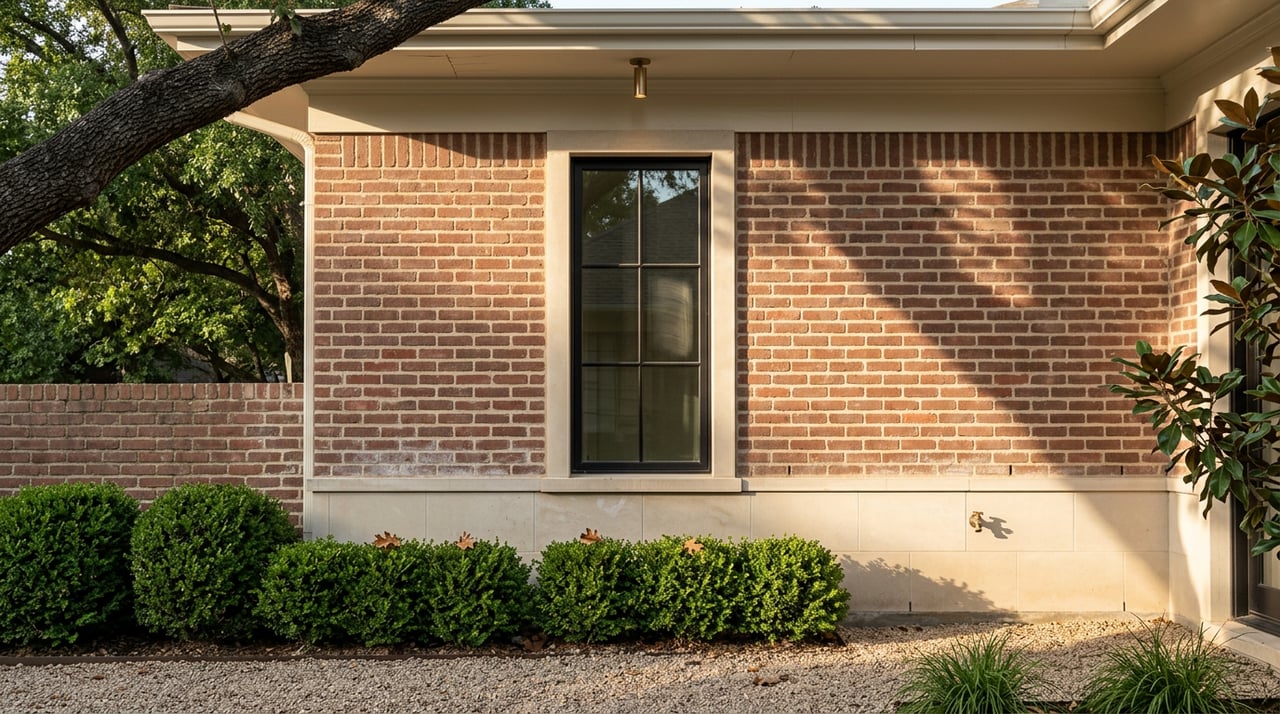
Walk a block off Tanglewood Boulevard in the spring of 2026 and you can stand between two homes built within a year of each other, on lots that look identical from the sidewalk, listed roughly half a million dollars apart. The portals will tell you one is "updated" and one is "original." That is not the real reason.
The real reason is that Tanglewood is not one market. It is twenty-three of them, stitched together under a single name, and the spread between any two lots is mostly a function of what the next owner is allowed to build.
The median is doing a lot of hiding
The Houston Association of Realtors reported the Tanglewood Area led all Houston luxury communities, defined as homes priced above $1 million, with a 25.0% year-over-year increase in sales in Q1 2026, an average price of $2,083,660, and homes spending an average of 25 days on the market. That is a tight, hot read on the top of the market.
Pull a different geographic cut from the same MLS, restricted to single-family resales above $125,000 and excluding properties trading at lot value, and the most recent monthly median lands closer to $1,555,000 with average days on market near 118. Same neighborhood. Different boundary, different filter, different story.
| Cut of the data | Price | Days on market |
|---|---|---|
| HAR Q1 2026 luxury (>$1M) | $2,083,660 avg | 25 |
| Resale, non-lot-value, trailing month | $1,555,000 median | 118 |
| 2024 appraised market value | $2,130,766 median | n/a |
The gap is not noise. The first number is what trades when somebody buys land and rebuilds. The second is what trades when somebody buys a house to live in as built. They are two different products on the same blocks, and they move on different clocks.
Twenty-three sections, written by hand
Tanglewood was platted starting in 1949 by William Farrington's Tanglewood Corporation, eventually reaching about 1,220 lots organized into 23 sections, numbered 1 through 19 with 4A, 11A, 11B, and 17A added later. Each section carries its own recorded restrictions. The Tanglewood Homes Association describes them as "virtually identical" across sections, with minor differences between them.
Those minor differences are where the money lives.
Across most sections the restrictions cover the same categories: residential use only, setback lines, matching roof and wall material and color between house and garage, the direction the residence must face, where garages may face the street, perimeter fence height and location, driveway entry location, and a prohibition on signs. The original language was drafted in 1949. Amendments were adopted in 2002 with more than seventy-five percent of residents voting in favor, and again in 2018, both rounds explicitly written to address larger two-story rebuilds and updates to the Texas Property Code.
For a buyer reading two listings, the practical translation is this: a lot in a section last amended in 2018 may permit a footprint, height, and garage configuration that a lot two streets away, governed by an older section file, will not. Two identical-looking ranches can carry different rebuild ceilings, and the market prices that difference into the dirt.
The City of Houston Planning Department, which publishes scanned section restrictions on its neighborhood page, puts the legal point plainly: deed restrictions in Houston can vary by subdivision, by section, and even by lot.
The review step that happens before the city sees your plans
Houston has no zoning. That part travels well. What travels poorly, and what catches relocation buyers most often, is the order of operations inside a deed-restricted neighborhood.
In Tanglewood, exterior work generally requires Tanglewood Homes Association approval before the City of Houston Permitting Center will accept the submission. Architectural review board sign-off is the first gate, not the last. Houston builders working in the inner Loop describe this sequence as the step that out-of-market buyers underestimate, with real consequences for budget and schedule when it gets skipped.
The friction is concrete:
- A boundary survey overlaid with the proposed footprint, confirming setbacks against the recorded section restrictions for that specific lot.
- THA review of roof and wall material, color match between house and garage, fence height and placement, driveway entry, and the orientation of the residence.
- Tree and drainage review, which matters more than it sounds, because Tanglewood's mature live oak canopy is one of the assets the restrictions are designed to protect.
- Only after that package clears does the city plan review begin.
For a buyer who plans to renovate rather than rebuild, the same gate applies in lighter form: any work outside the home generally requires THA approval. That is a closing-table conversation, not a fun-to-discover one six months in.
What 1661 Tanglewood Boulevard actually proved
The clearest public proof that Tanglewood's restrictions are not uniform is the long-running fight over 1661 Tanglewood Boulevard, the corner at San Felipe where Tanglewood Corporation's office has sat for nearly seventy years.
When that corner was first platted, it was reserved for commercial or residential use and declared unrestricted in the recorded deed restrictions. That single carve-out, written into the neighborhood's founding documents, is what allowed Kendall Miller and his family, through Tanglewood Corp. and WMJK Ltd., to advance a high-rise project on the site, and what a District Court judge cited in ruling that the family could use the property for the proposed tower. The Tanglewood Homes Association's counter-argument turned on whether subsequent amendments, dating back to 1997, had reshaped the original carve-out.
A buyer does not need a view on who is right in that dispute to absorb the takeaway. The takeaway is that the document attached to a specific lot is the document that matters. A general statement about "Tanglewood deed restrictions" is the wrong unit of analysis. The right unit is the section file, the lot's plat, and any amendments that apply to it.
Reading a Tanglewood listing like a buyer who knows the math
The Q1 2026 HAR numbers, twenty-five days on market at a $2 million average, describe the rebuild-ready segment. The slower, lower median describes the as-built segment. A buyer who treats Tanglewood as one market will overpay in one segment and underbid in the other.
A short checklist for a buyer walking a Tanglewood property:
- Pull the recorded restrictions for the specific section. The City of Houston publishes scanned section files, and the THA references them by section number on its deed restriction history page.
- Confirm the lot's section and whether it was touched by the 2002 or 2018 amendments. Two homes facing each other across a street can sit in different sections.
- Ask the listing agent for the THA file on the property, including any prior approvals, denials, or open violations. Open items convey to the next owner.
- Verify lot dimensions against the section's setback and orientation language before assuming a particular footprint, second story, or garage placement is achievable.
- If the plan is to renovate rather than rebuild, scope exterior changes against the same review process. Fences, driveways, roof material, and exterior color are all in scope.
The market already prices this work into transactions. Active builders writing in Tanglewood right now, including Allan Edwards with Brickmoon Design and Benjamin Johnston Design, Charter Custom Homes, and Stacey Fine Homes, run the section review in parallel with feasibility. The buyer's leverage comes from doing it before the offer, not after.
A short FAQ
Is Tanglewood under one HOA? Yes. The Tanglewood Homes Association, chartered in 1948, governs all 23 sections. The single association enforces 23 separate sets of restrictions that share most of their language and differ in places that matter for construction.
Why does a 16,500 square foot lot in Tanglewood not behave like a 16,500 square foot lot in Memorial? Memorial includes incorporated cities, Bunker Hill, Hunters Creek, Piney Point, that run their own permitting and ordinances. Tanglewood sits inside Houston city limits, where deed restrictions and THA review do the work that municipal ordinances do elsewhere. The constraint is real in both places. The paperwork lives in different buildings.
Does the section-by-section variation matter if I am not planning to rebuild? Yes, at resale. The buyer behind you is pricing rebuild rights into the offer whether you used them or not. The lot's section file is part of what they are buying.
If you are weighing a Tanglewood purchase and want the section file, prior THA approvals, and rebuild ceiling pulled before you write an offer, the team at Nan and Company Properties does that work as part of every Tanglewood engagement. Discover the Nan Difference.